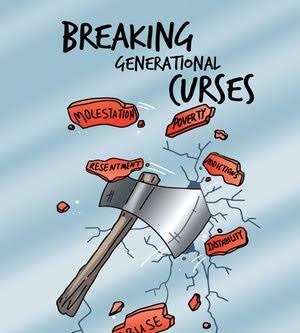
Have you ever asked yourself:
“Why am I struggling with something that seems to have followed my family for generations?”
Perhaps there is a repeated pattern of anger, broken relationships, poverty, addiction, barrenness, premature death, occult involvement, idolatry, or destructive behaviour in your family.
You love God.
You pray.
You fast.
You study the Bible.
You attend church.
You go for overnight prayers and keshas.
You serve God and may even preach powerfully.
Yet, something seems to keep repeating.
Could there be a spiritual dimension to what you are experiencing?
The Bible does speak about the consequences of ancestral sin extending across generations. Exodus 20:5 warns that God visits “the iniquity of the fathers upon the children unto the third and fourth generation” of those who hate Him.
But this subject requires careful biblical understanding. Scripture does not teach that every difficulty is automatically a generational curse, nor that a believer is helplessly imprisoned by the sins of an ancestor.
The good news is that Christ provides freedom.
What Does the Bible Say About Generational Iniquity?
Exodus 20:5 speaks about the consequences of idolatry and rebellion being carried through generations.
The important point is that Scripture connects this warning with those who continue in hatred and rebellion against God. It is not teaching that God randomly punishes innocent descendants simply because of their family name.
This distinction matters.
A family may carry a destructive pattern without every member personally committing the original sin.
For example, one generation embraces occult practices. The next generation grows up around those practices. Children inherit beliefs, behaviours, fears and spiritual environments. The pattern can continue until somebody recognizes it, renounces it and turns completely to God.
That is why we must examine our spiritual heritage.
What Did Your Ancestors Worship?
Ask difficult questions:
- Did my ancestors worship other gods?
- Was witchcraft practised in my family?
- Were sacrifices made to spirits?
- Were covenants made with idols?
- Were there repeated patterns of violence?
- Was there persistent sexual immorality?
- Were there family members who practised divination?
- Are there destructive patterns that appear repeatedly across generations?
- What behaviours seem strangely persistent in my family?
These questions are not meant to produce fear.
They are meant to produce discernment.
Genesis 49: When the Actions of One Generation Affect Another
Genesis 49 gives us a remarkable picture of how the actions of fathers could have consequences for their descendants.
Jacob addressed his sons before his death.
Consider Reuben.
Reuben had committed a serious sexual offence involving his father's concubine. Jacob therefore declared that Reuben would not excel.
This was not merely a private family disagreement. Jacob spoke about consequences affecting Reuben's future. It means no one would excel in that bllodline, until something happens!
Then we come to Simeon and Levi.
Jacob remembered their violent response at Shechem. Their anger had resulted in bloodshed. Jacob therefore declared that their anger be scattered in Israel. It became a curse.
The words were:
“I will divide them in Jacob,
And scatter them in Israel.”
— Genesis 49:7
Here we see an important biblical principle:
What happens in one generation can create consequences that reach into another.
But there is also another important lesson.
Levi's story did not end with Genesis 49.
God later used the tribe of Levi for priestly service.
That should give every believer hope.
A family history does not have to become your destiny.
Moses: A Man of God Who Still Struggled With Anger
Now consider Moses.
Moses was one of the greatest servants of God in the Old Testament.
He encountered God at the burning bush.
He confronted Pharaoh.
He led Israel out of Egypt.
He stretched out his staff over the Red Sea.
He received God's commandments.
He interceded for Israel.
He spoke with God in a unique way.
Yet Moses had a serious problem with anger.
At one point, God instructed Moses to speak to the rock. Instead, Moses struck the rock twice in anger.
Numbers 20 records the consequence.
God told Moses that because he had not honoured Him as holy before Israel, Moses would not lead the people into the Promised Land.
That is sobering.
Moses was holy in his calling, powerful in ministry and deeply used by God—but he still had an area of weakness that had consequences. He did not fulfil his purpose-leading the children of israel from Egypy to Canaan.
Where Did Moses' Anger Come From?
Here we need to be careful.
Moses was a descendant of Levi, and Genesis 49 records Jacob's words concerning Levi's violence and anger.
The direct biblical genealogy from Levi to Moses (and Aaron) traces through the tribe of Levi as follows: [1]
Levi (son of Jacob and Leah)
Kohath (son of Levi)
Amram (son of Kohath, who married Jochebed, Levi's daughter/aunt)
Moses and Aaron (sons of Amram and Jochebed).
Moses anger may have been a generational curse inherited from Levi.
Moses belonged to the tribe of Levi, and Scripture records both Levi's violence and Moses' later struggle with anger.
Are there patterns in your family that you need to confront rather than simply tolerate?
You Can Love God and Still Have a Family Pattern to Confront
Consider the Christian who has a problem with anger.
He loves Jesus.
He reads the Bible.
He prays.
He fasts.
He preaches.
God uses him powerfully.
But suddenly something happens.
He explodes.
He becomes abusive with words.
He destroys relationships.
Later he regrets it and asks God for forgiveness.
Then the cycle repeats.
Perhaps his father had the same problem.
His grandfather had the same problem.
His great-grandfather was known for violence.
Does that automatically prove a generational curse?
No.
There may be spiritual, behavioural, emotional, environmental and learned components as well.
But the pattern should not simply be ignored.
Instead, it should become a matter of repentance, discipleship, prayer, spiritual warfare and practical transformation.
Christians should not use “generational curse” as an excuse for sinful behaviour.
At the same time, we should not ignore persistent family patterns that need to be confronted.
What About Elizabeth's Barrenness?
Luke 1 gives us another fascinating example.
Zechariah and Elizabeth were described as righteous before God and walking blamelessly in His commandments.
Yet Elizabeth was barren.
Luke says:
“But they had no child, because that Elisabeth was barren.”
— Luke 1:7
This is important because barrenness did not mean Elizabeth was living in rebellion against God.
She was also a descendant of Aaron.
Elizabeth's barrenness may hve been a generational curse inherited from Aaron.
Aaron did participate in the golden-calf incident in Exodus 32.
Elizabeth's story therefore teaches something equally important:
Not every persistent problem is a curse.
Sometimes the believer must discern rather than assume.
Her barrenness eventually became the setting for a miraculous intervention from God—and she became the mother of John the Baptist.
Why Doesn't Prayer Always Produce Immediate Change?
This is where many believers become discouraged.
They say:
“I have prayed.”
“I have fasted.”
“I have attended kesha.”
“I have read the Bible.”
“I have gone for deliverance.”
“Why hasn't anything changed?”
There can be many reasons.
Sometimes there is an area of unrepented sin.
Sometimes there is a learned family pattern.
Sometimes there are consequences of past decisions.
Sometimes there are spiritual strongholds.
Sometimes there are relational or psychological issues requiring wise counsel and practical change.
And sometimes we simply do not know why God has permitted a particular trial.
Therefore, we should never automatically conclude:
“Nothing has changed because I have a generational curse.”
Instead, ask God for discernment.
How Do You Break Ungodly Family Patterns?
The answer is not fear.
The answer is Christ.
Galatians 3:13 declares that Christ redeemed us from the curse of the law by becoming a curse for us.
This means the believer does not have to live under the authority of ancestral sin and curses.
1. Identify the Pattern
Look honestly at your family history.
What keeps repeating?
Do not investigate merely to become afraid.
Investigate so that you can pray intelligently.
2. Renounce Idolatry and Sin
If your ancestors practised idolatry, occultism or other forms of rebellion against God, do not continue those practices.
You cannot break a pattern while deliberately participating in it.
3. Repent Personally
You cannot repent for an ancestor as though you personally committed their sin.(identificational repentance)
But you can confess your own participation in sinful patterns and deliberately turn away from them.
4. Put Your Faith in Christ
Your identity is not ultimately determined by your surname, tribe, clan or ancestry.
You belong to Christ.
Your past may explain some things, but it does not have the final word over your future.
5. Renew Your Mind
Romans 12:2 calls believers to be transformed by the renewing of their minds.
Some family patterns require spiritual warfare.
Others also require learning a new way of thinking and behaving.
If anger has been normal in your family, learn self-control.
If dishonesty has been normal, practise truth.
If sexual immorality has been repeated, establish godly boundaries.
If financial irresponsibility has been inherited, learn stewardship.
Deliverance and discipleship should work together.
Who Are You a Descendant Of?
This question is worth asking—not to live in fear, but to understand your history.
Who were your great-grandparents?
What did they believe?
What did they worship?
What covenants did they make?
What patterns characterized their lives?
What patterns have continued?
And perhaps most importantly:
What ends with you?
You can decide that certain patterns will not continue into your children.
You can become the generation that says:
“This ends here.”
Not because you are stronger than your ancestors.
Not because you have enough fasting hours.
Not because you have attended enough keshas.
But because Jesus Christ has purchased your freedom and called you to walk in it.
Disconnect From Ungodly Patterns and Connect With Christ
Generational history matters, but it does not have to become generational destiny.
Moses' story reminds us that even a great servant of God must deal seriously with personal weaknesses.
Genesis 49 reminds us that actions can have consequences beyond one generation.
Exodus 20 warns about the multigenerational consequences of idolatry.
Elizabeth reminds us that not every affliction is a curse—and that righteous people can experience painful seasons without God having rejected them.
Therefore, don't diagnose everything as a curse.
Discern. Pray. Repent. Renounce ungodly practices. Seek wise counsel. Renew your mind. And above all, stand in what Christ has accomplished.
The question is not merely:
“What came down my bloodline?”
The deeper question is:
“What will I allow to continue through me?”
Your family history may explain where some patterns began.
But in Christ, it does not have to determine where your story ends.
Break agreement with sin. Break partnership with darkness. Break destructive patterns. Establish a new godly legacy.
Know who you are in Christ—and walk in the freedom He has given you.

